
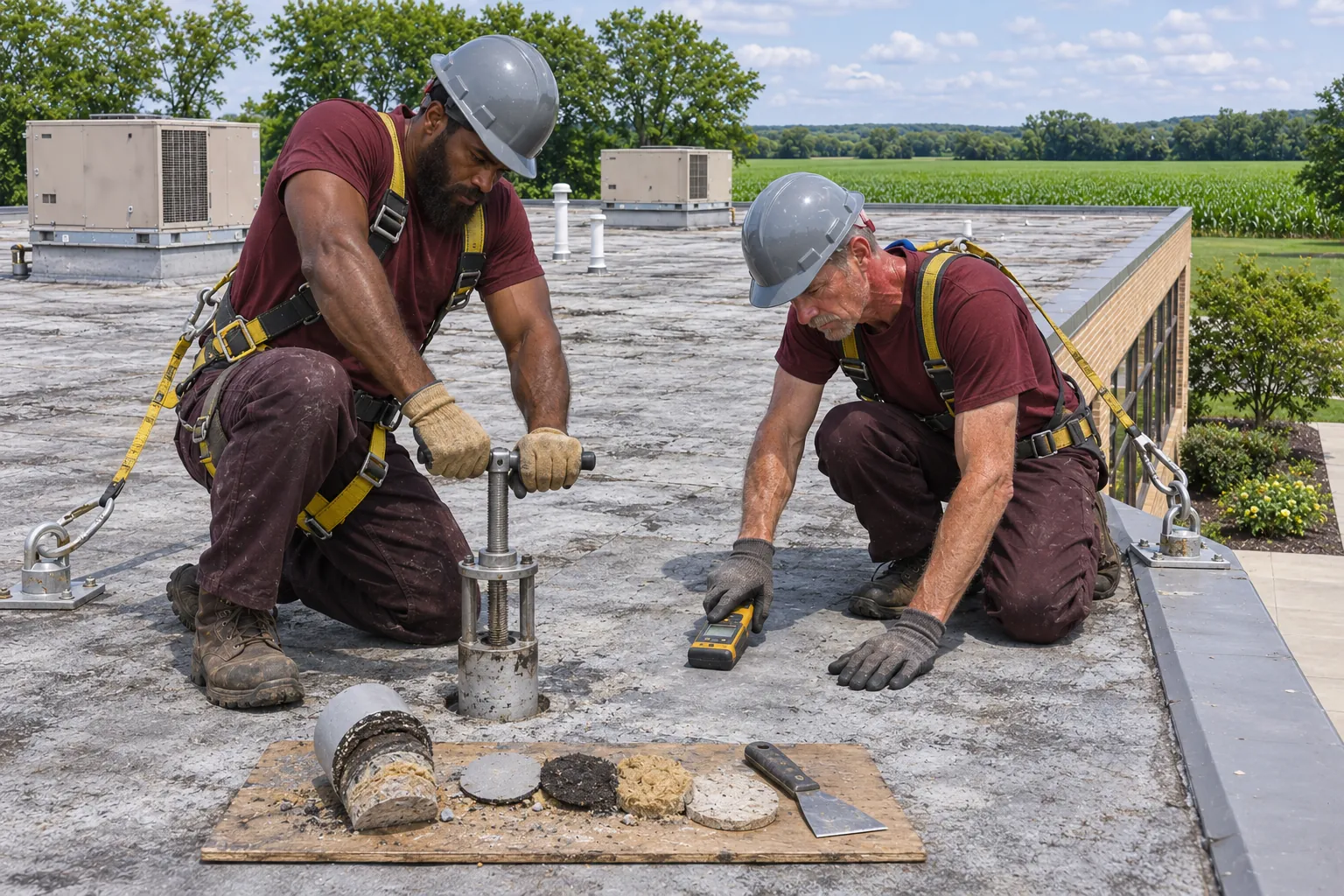
Columbus Commercial Roof Repair FAQ
Plain Answers on Leaks, Drains, Metal Panels, and Plant Roofs
Our Columbus commercial roof repair FAQ answers 32 questions building owners ask about flat, metal, leak, and industrial roof repair.
- Questions
- Thirty-two answers in seven topics
- Topics
- Flat, metal, leak, and plant roofs
Columbus Commercial Roof Repair FAQ by Topic
The Columbus commercial roof repair FAQ below is grouped into seven topics. Jump to the one that matches your roof.
Columbus Commercial Roof Repair FAQ: First Questions
Inspections, hail, roof emergencies, what moves the cost, engine plant roofs, and freeze-thaw damage.
What is included in a commercial roof inspection in Columbus, IN?
A commercial roof inspection in Columbus, Indiana covers the roof surface, seams, flashing at walls and curbs, drains, gutters, penetrations, and edges, plus interior signs such as ceiling stains. We probe soft spots, note ponding and punctures, and photograph each problem. The owner gets a written list that separates urgent repairs from items to monitor.
How is hail damage repaired on Columbus, IN commercial roofs?
Hail repairs start with documenting the damage for any insurance claim. On membrane roofs, fractured or bruised areas are cut out and patched and wet insulation is replaced. On metal roofs, split laps, cracked fastener washers, and broken trim and skylights are repaired. Each repair matches the existing roof system.
What should a Columbus, IN facility do in a roof emergency?
Keep people and equipment away from the leak, contain the water, and cut power to wet areas near electrical equipment. Photograph the damage and note the time. A commercial roofer can then install a temporary patch to stop water entering, and complete the permanent repair after the source is traced and the roof is dry.
What affects commercial roof repair cost in Columbus, IN?
Repair cost depends on the roof type, the size of the damaged area, wet insulation, flashing or drain work, access, and how hard the leak is to trace.
A failed pipe boot is a small repair; a wet section of insulation is a larger one. Every Columbus, Indiana repair is priced through a free on-site estimate.
Do you repair roofs on Columbus engine plants?
Yes. Engine plant roofs carry heavy rooftop equipment, exhaust stacks, and process penetrations, and repairs often happen over active lines.
We work from the roof surface, protect areas below when the deck is opened, and schedule hot work and lifts with the plant's safety staff. Membrane near exhausts is repaired with materials suited to that exposure.
How do freeze-thaw cycles damage Columbus, IN commercial roofs?
Water gets into small cracks and open seams, freezes, expands, and widens them. When it thaws, more water gets in, and the cycle repeats through the winter. Ice at drains and gutters also backs water onto the roof. Repairing seams and flashing in fall and keeping drains clear limits freeze-thaw damage on Columbus buildings.
Flat Roof Repair Questions From Columbus Owners
Repair methods, blisters, winter leaks, heavy-rain leaks, and how long water can stand.
What is the best way to repair a flat roof on a Columbus, IN light industrial building?
Start by tracing the real entry point, since water often travels before it drips. Then cut out the damaged membrane and any wet insulation and rebuild that area in kind, so new material bonds to the old.
A tape-and-caulk patch over a wet roof only holds briefly; a repair in matching material, tied in with proper laps, lasts.
How are flat roof blisters repaired in Columbus, IN?
Small blisters that are intact are usually watched rather than cut. Blisters that have cracked, are growing, or sit in traffic paths are opened, dried out, and sealed under a patch of compatible membrane. When blisters appear across much of the roof, we check for wet insulation underneath, which signals a larger moisture problem.
Should a Columbus, IN business wait until spring to fix a flat roof leak?
No. Waiting lets water soak insulation and rust or rot the deck, which turns a patch into a section replacement.
On a cold day, we make a temporary seal that stops the water, using cold-weather products where adhesives will not cure. The permanent repair follows on the next mild, dry stretch, often within the same winter.
Why does my Columbus, IN flat roof leak in heavy rain?
Heavy rain overloads weak points that light rain does not reach. Clogged drains and scuppers let water rise above flashing heights, and ponding water finds open seams and small punctures.
Leaks that show only in heavy rain often point to drainage problems or flashing set too low. We trace the source and fix drainage along with the leak.
How long can water sit on a Columbus, IN flat roof before it is a problem?
Many roofing guidelines treat water still standing about two days after rain as ponding that needs attention. Long-standing water speeds membrane wear, adds weight to the deck, and pushes into any small opening.
We find why the water stays, often a blocked drain or a low area, and correct it with drain work or tapered insulation.
Commercial Metal Roof Repair Questions
Life expectancy, flashing, hail, the most common leak cause, and single-panel swaps.
What is the life expectancy of a commercial metal roof in Columbus, IN?
Commercial metal roofs often last 30 to 50 years with repairs and maintenance. Fasteners, sealants, and flashing wear out well before the panels, so regular fastener checks matter. Panel finish, gauge, and exposure to moisture or chemicals all affect how long the metal lasts on a Columbus building.
Why does flashing fail first on Columbus, IN metal roofs?
Flashing sits where the roof changes direction or meets something, such as a wall, curb, ridge, or pipe, so it takes the most movement and the most water.
Sealant behind trim dries out, closures shrink, and short laps let water blow under. Repairs replace the trim and sealant, and add longer laps or hemmed edges where the original detail was too thin.
How are metal roofs repaired after hail in Columbus, IN?
After documenting the damage, we inspect each panel run for split laps, cracked fastener washers, holed panels, and broken skylights and trim. Dents alone rarely leak, so dented panels without cracks usually stay. Holed or cracked panels are replaced, and every broken seal is redone.
What is the most common cause of metal roof leaks in Columbus, IN?
Fasteners are the most common cause. Rubber washers age and crack, and panel movement from temperature swings backs screws out, leaving holes for water. Open laps and failed flashing at curbs and walls are close behind. We replace or reseal fasteners, seal laps, and repair flashing to stop these leaks.
Can rusted panels on Columbus, IN farm buildings be replaced one at a time?
Yes. Individual metal panels can be unfastened and replaced when rust has eaten through, as long as a matching profile is available.
The new panel laps under and over its neighbors like the original, with new fasteners and sealant. If rust has spread across many panels, we lay out the repair and replacement options side by side for the owner.
Question About Your Own Roof?
Call and describe what you see. A short conversation often points to the detail worth checking first.
Commercial Roof Leak Repair Questions
Snowmelt leaks, parapet walls, ice dams, heavy-rain leaks, and rooftop unit curbs.
Why do leaks show up in Columbus, IN buildings a few days after a snowfall?
Snow sits on the roof as a slow water source. As it melts in daytime sun, water runs under the snow to drains that may still be frozen, so it backs up against curbs and walls longer than any rainstorm would.
Seams that opened during the cold let it in. The delay between snowfall and drip is a strong clue for tracing the leak.
What causes a roof leak at a parapet wall on Columbus, IN buildings?
Most parapet leaks start above the roof surface rather than on it. Water gets in through gaps in the metal or stone wall cap, through mortar joints in brick parapets, or behind counterflashing whose sealant has dried out, then runs down inside the wall and shows up at the roof line.
Our repair targets that entry point first, then the base flashing where the wall meets the roof.
Where do ice dams form on Columbus, IN commercial roofs, and how are the leaks stopped?
On commercial buildings, ice dams usually form at gutters, low eaves on metal roofs, and scuppers on flat roofs, where meltwater reaches a cold edge and refreezes.
The trapped water then seeps under laps and trim. We reseal the eave laps and edge flashing, open up frozen scuppers, and point out heat loss at the roof edge that keeps the cycle going.
Is it normal for a Columbus, IN commercial roof to leak in heavy rain?
No. A roof in good condition should not leak in heavy rain. When leaks appear only during downpours, the usual causes are clogged drains, water rising above flashing, open seams in ponding areas, or overflowing gutters. These problems are repairable once found, and finding them early prevents insulation and deck damage.
Why do rooftop unit curbs leak on Columbus, IN commercial buildings?
Curbs leak when the membrane flashing pulls away from the curb, the counterflashing or unit gasket fails, or the curb sits too low for water that ponds around it. Technicians servicing units also step on and crack the flashing. We reflash the curb, reseal the unit, and add walkway pads on the service path.
Industrial Roof Repair Questions From Columbus Plants
Hiring questions, repairs over running lines, drains, leak methods, and wear around equipment.
What questions should a Columbus, IN plant ask before hiring for industrial roof repair near me?
Ask whether the roofer will trace the leak before quoting, how they protect production below, and whether they follow your plant's hot work, lockout, and fall-protection rules. Ask which material they will use for your roof type and any chemical exposure. Clear answers in writing show the crew has done repairs over working plants before.
Can a Columbus, IN plant keep running while its roof is repaired?
Yes, in most cases. Repairs over a running plant are planned with the plant manager: which bays can tolerate overhead work, when lines change over, and where tarps or catch decks go if the deck is opened.
Most leak repairs never open the deck at all, so the floor below sees nothing more than a brief stop near the work area.
Why do drains on Columbus, IN industrial roofs leak?
Drains leak where the membrane meets the drain bowl. Clamping rings loosen or crack, bolts rust, and membrane pulls back from the flange as the roof moves. Debris from rooftop equipment clogs strainers, so water stands and finds those gaps. We reset the clamp with new bolts, re-terminate the membrane, and replace missing strainers.
How are leaks repaired on Columbus, IN industrial roofs?
Industrial roof leaks are traced from the drip point up the slope to the source, which is often a curb, exhaust fan, pipe penetration, or seam damaged by equipment service. We repair the source with material suited to any heat or chemical exposure, replace wet insulation, and add walkway pads where traffic caused the damage.
Why do industrial roofs on Columbus light industrial buildings wear out around equipment?
Rooftop equipment brings vibration, heat, exhaust residue, and frequent technician traffic, all of which wear membrane and flashing. Dropped tools and screws puncture the roof, and vibration loosens flashing. We repair these areas with reinforced material, add walkway pads, and check curbs for height and sealing.
Permits and Codes in Columbus, Indiana
Which office handles building permits for Columbus and which state code sets the rules.
Do commercial roof repairs in Columbus, IN need a permit?
Small patch repairs and large re-roof sections can be treated differently, so ask before work starts. For Columbus, the Bartholomew County Department of Technical Code Enforcement is the office for building permits and inspections. At the state level, the Indiana Building Code in 675 IAC 13 sets the rules for commercial construction.
Repair Questions From Towns Near Columbus
Seymour, Greensburg, Madison, Batesville, and North Vernon, each with the roof work asked about most there.
Do you repair warehouse and plant roofs in Seymour?
Yes. Warehouses and plants in Seymour often have large low-slope roofs with busy rooftop equipment and service traffic. We repair membrane, metal panels, flashing, and drains on these buildings and coordinate access with shipping and production schedules. Each repair comes with photos so owners can see what was fixed.
Do you repair metal roofs in Greensburg?
Metal roofs on commercial, industrial, and farm buildings in Greensburg are part of our repair work. Common repairs include replacing fasteners, sealing laps, replacing rusted panels, and new flashing at ridges and walls. Repairs are matched to the existing panel profile and finish.
Do you fix roof leaks in Madison?
We fix roof leaks on commercial and industrial buildings in Madison, including leaks at drains, parapets, curbs, and seams. Older buildings may have several roof layers, so we check what is underneath when tracing a leak. Wet insulation found during the repair is replaced.
Can you repair roofs on Batesville manufacturing buildings?
Roofs on manufacturing buildings in Batesville are repair work we take on, including leaking curbs, failed seams, worn areas along service paths, and drains that pond.
Before work starts, we review the plant's safety rules and agree on which roof sections can be worked during each shift. Patches near exhaust fans use materials suited to heat and residue.
Do you repair flat roofs in North Vernon?
Yes. We repair flat roofs on commercial buildings in North Vernon, including TPO, EPDM, and modified bitumen. Repairs cover seams, punctures, blisters, drains, and flashing. Drainage is checked during each repair, since ponding water is behind many flat roof leaks.
Columbus Commercial Roof Repair FAQ: Ask Us Directly
If your question is still open, call or request an estimate. We will answer it on the roof itself.